


Data is more important than ever in helping make decisions. But while descriptive analytics tells us what happened, and predictive analytics tells us what might happen, prescriptive analytics takes it one step further. It doesn’t even end with predictions. It offers practical advice for companies to make the most informed decisions.
In the following post we will dive into prescriptive analytics. At the end of this, you’ll know what this powerful tool is and how it can change the future of decision-making in several industries.
What is Prescriptive Analytics and Why is it Important?
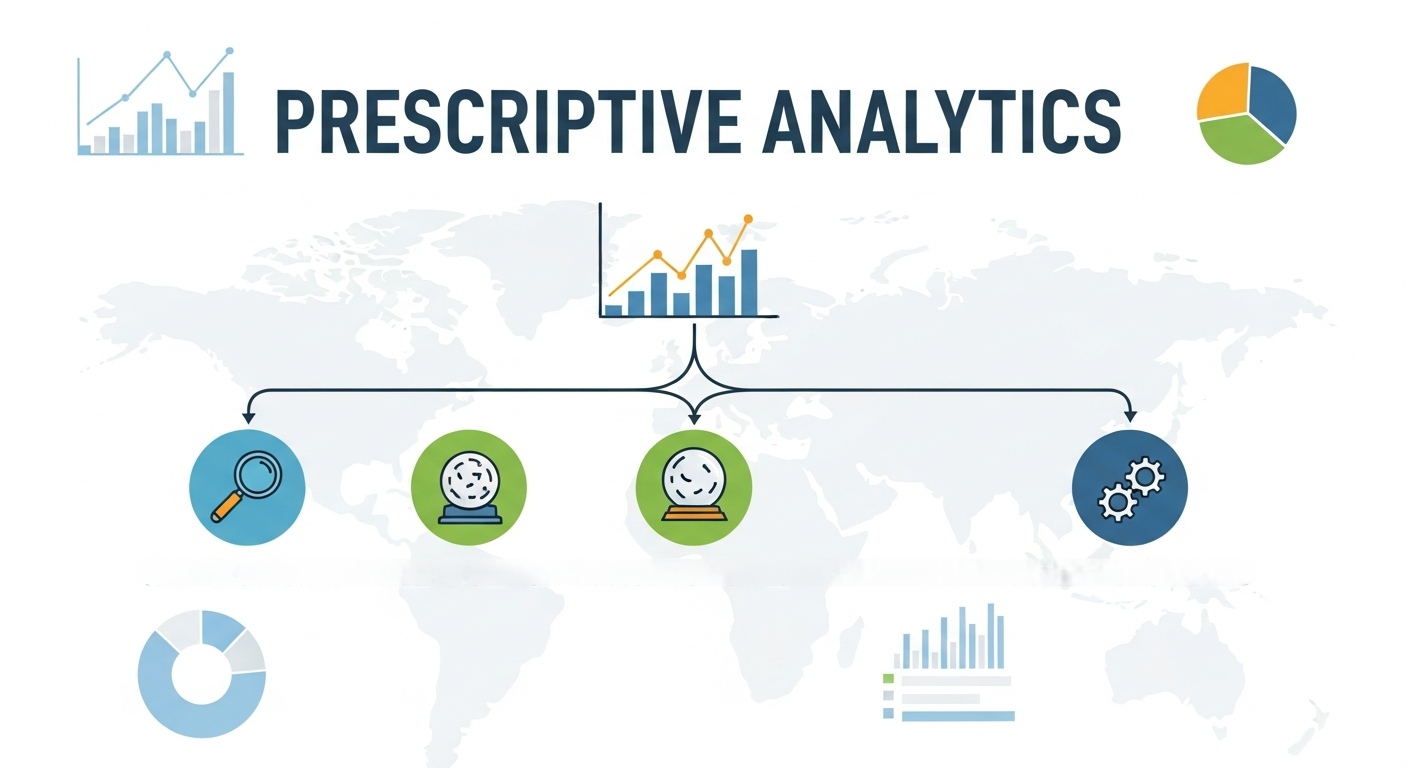
Essentially, prescriptive analytics is the use of data to inform you of the right actions to apply in decision-making. Leveraging advanced technologies such as optimisation, simulation models and machine learning algorithms, it does more than mere forecasting, answering the all-important question “What should we do?”
That’s not just a luxury for businesses in fast-moving, data-rich settings. It’s a game-changer. By enabling insight to action, it accelerates the ability for companies to discover, adapt and compete, turning how we work into how we win.
While prescriptive analytics is widely used in business decision-making, the term ‘analytical’ also appears in academic contexts, like analytical physics on the MCAT.
Fundamental Principles of Prescriptive Analysis

The best way to explain prescriptive analytics is by unscrambling its core elements. Here’s how it works:
Optimization
At the core of prescriptive analytics is optimization. It’s all about finding the “most optimal” answer depending on the situation, whether that’s maximizing profits, minimizing costs or increasing efficiency. For example, airlines already incorporate optimization to handle their schedules of flights to maintain a trade off between customer satisfaction and operation cost.
Simulation
Simulation models enable the businesses to experiment with scenarios without taking any risk. These simulation methods – by creating representations of real-world conditions – allow organizations to prepare for potential results and adjust strategies as necessary. It’s like a magic decision-making crystal ball.
Decision Rules
Decision rules are also a dependence in prescriptive analytics. These are pre-specified set of conditions/rules that form the basis of decision making, when in a situation. For instance, a logistics manager could apply decision rules to trigger the reordering of the inventory once it’s deplenished to a certain point.
Role of Prescriptive Analytics in Strategic Planning
Prescriptive analytics plays a crucial role in strategic planning by helping organizations choose the best long-term actions based on data-driven insights. Instead of relying only on intuition or past experience, leaders can use prescriptive models to evaluate multiple strategic options and understand their potential outcomes. These insights help organizations allocate resources more effectively, set realistic goals, and reduce uncertainty in decision-making. By combining historical data, predictive forecasts, and business constraints, prescriptive analytics ensures that strategies are both practical and achievable. As markets become more competitive and unpredictable, using prescriptive analytics in strategic planning allows companies to stay agile, proactive, and better prepared for future challenges.
Prescriptive Analytics and Risk Management

Risk management is one of the most valuable use cases of prescriptive analytics. Organizations face risks related to finance, operations, compliance, and market volatility. Prescriptive analytics helps identify these risks early and recommends actions to minimize their impact. By simulating different risk scenarios, businesses can understand how various decisions may affect outcomes and choose safer alternatives. This approach is especially useful in industries where even small mistakes can lead to significant losses. Prescriptive analytics transforms risk management from a reactive process into a proactive one, enabling organizations to anticipate threats, prepare mitigation strategies, and make informed decisions with greater confidence.
Improving Operational Efficiency with Prescriptive Analytics
Operational efficiency is critical for maintaining profitability and competitiveness. Prescriptive analytics helps organizations streamline processes, reduce waste, and optimize resource utilization. By analyzing operational data, it identifies bottlenecks and recommends improvements that can save time and costs. For example, companies can optimize workforce scheduling, production planning, and inventory management using prescriptive models. These insights allow managers to take immediate action rather than relying on trial-and-error approaches. Over time, continuous use of prescriptive analytics leads to more consistent performance, faster decision-making, and improved overall productivity across departments.
Prescriptive Analytics in Customer Experience Management
Understanding and improving customer experience is a priority for many businesses. Prescriptive analytics helps organizations analyze customer behavior, preferences, and feedback to recommend actions that enhance satisfaction and loyalty. Instead of simply identifying trends, it suggests personalized offers, optimal communication timing, and service improvements. Businesses can use these insights to reduce customer churn, increase engagement, and build stronger relationships. By applying prescriptive analytics, companies can deliver more relevant experiences while ensuring that customer-focused decisions align with business objectives and operational constraints.
Data Quality and Its Impact on Prescriptive Analytics

The effectiveness of prescriptive analytics depends heavily on data quality. Accurate, complete, and timely data is essential for generating reliable recommendations. Poor data quality can lead to incorrect insights and flawed decisions. Organizations must invest in strong data governance practices, including data validation, cleaning, and standardization. Ensuring consistency across data sources improves model performance and decision accuracy. When data quality is prioritized, prescriptive analytics becomes a powerful and trustworthy tool that supports confident decision-making across all levels of the organization.
Ethical Considerations in Prescriptive Analytics
As prescriptive analytics becomes more advanced, ethical considerations play an increasingly important role. Automated recommendations can influence major decisions, making transparency and fairness essential. Organizations must ensure that models are free from bias and that decision logic is understandable to stakeholders. Human oversight remains critical to evaluate recommendations and align them with ethical standards and organizational values. Responsible use of prescriptive analytics helps build trust, protects stakeholder interests, and ensures that data-driven decisions benefit both businesses and society.
Applications of Prescriptive Analytics in the Real World
Prescriptive analytics is a flexible capability and is applicable to virtually all industries. Here are a few 200 proofs of how it helps revolutionize operations:
Healthcare
The Role of Prescriptive Analytics in Optimising Patient Outcomes and Operational Efficiency. For instance:
-
Hospitals use it to staff at the proper level so that the well-being of patients is balanced with the cost of serving them.
-
It is also used in the management of treatments, recommending the best course of action for individual patients depending on their medical history and continued symptoms.
Supply Chain Management
For supply chains, where accuracy is crucial, prescriptive analytics is a game-changer. For example:
-
Retailers use it to forecast demand and keep inventories at a more optimal level, avoiding both overstocking and out-of-stock situations.
-
Logistics companies use it to find the most efficient delivery routes to reduce fuel consumption and take the “fast lane” of shipping.
Finance
The following is the reasons why the financial industry has adopted prescriptive analytics:
-
Assist investors in portfolio management by advising best asset allocation according to market conditions.
-
On some level, the role is pretty straightforward: identify and manage risks (whether financial, fraud, or credit risk) by using massive amounts of data to develop solutions.
Advantages of Prescriptive Analytics
What’s more, prescriptive analytics has plenty of benefits in adoption, as well, giving organizations:
-
Better Choices: It is data analysis coupled with actionable insights so no guess work is involved.
-
Increase Efficiency: Computers reduce the need for manual handling of information, which helps companies perform more with fewer resources.
-
Gain a Competitive Edge: Organizations that utilize prescriptive analytics have the edge over their competitors by reacting faster and more intelligently to market shifts.
For example, a retailer with a strong prescriptive analytics capability is able to optimize prices in real time by continuously monitoring competitors’ information to ensure they have the most competitive prices with the highest margins.
Overcoming the Challenges
Though prescriptive analytics promises great value, it’s not without its difficulties:
-
Large Data Requirement: It depends on huge amount of data with high quality. Imitation and fallible data can lead to compromised results.
-
Model Complexity: It is difficult and expensive (in terms of expertise, time, and investment) to create and maintain sophisticated models.
-
Obstacles in Implementation: There may be resistance within organizations to adopt new technologies or it can be difficult to incorporate them into current systems.
Organisations need to meet these challenges through strong data governance, upskilling their teams and partnering with prescriptive analytics vendors that have a proven track record in successful execution.
The Horizon for Prescriptive Analytics
Prescriptive analytics’ future appears to be quite shiny, considering the rate at which technology is advancing and adoption. Major trends in the field are:
Integration With AI and Machine Learning
Thanks to AI-fueled prescriptive analytics, decisions are becoming yet smarter, faster and more adaptable. ML models keep learning from the data & keep getting better and better over time.
Wider Industry Adoption
Prescriptive analytics is already in use in verticals such as healthcare and finance, and it’s gaining ground in sectors such as education, energy, and public safety. Schools, for example, are already using prescriptive analytics to chart personalized learning paths for students.
Real-time Decision-making
With the advent of the Internet of Things and real-time data streams, prescriptive analytics is beginning to give instant advice. Picture a factory that adapts even before a product line goes down from an error detected by its sensors.
Get More Value out of Your Data with Prescriptive Analytics
Prescriptive analytics is leading the way in data-informed decision-making. It uses optimization, simulation and AI to enable organizations to generate actionable insights. Whether it is improving patient care, streamlining supply chains or strengthening financial strategies, the possibilities are endless.
Yet prescriptive analytics is a strategic journey that involves the right tools and skill sets. The companies that play the long game and invest in developing a strong infrastructure now will reap the rewards in the future.
The time is NOW for your organisation to start investigating prescriptive analytics services if you don’t want to be left behind. It’s time to redefine how data can transform your organization and how it works for you.
Future Skills Required for Prescriptive Analytics Adoption
Successful adoption of prescriptive analytics requires more than just technology. Organizations need skilled professionals who understand data, business processes, and analytical models. Skills such as data interpretation, problem-solving, and critical thinking are essential for translating recommendations into action. Training employees and building cross-functional teams ensures that insights are effectively implemented. As prescriptive analytics continues to evolve, organizations that invest in talent development will be better positioned to maximize its value and maintain a competitive edge.
Frequently Asked Questions (FAQ)
1. What is prescriptive analytics in simple terms?
Prescriptive analytics is an advanced form of data analytics that not only predicts future outcomes but also recommends the best actions to take. It helps organizations make informed decisions by combining data, business rules, and advanced algorithms.
2. How is prescriptive analytics different from descriptive and predictive analytics?
Descriptive analytics explains what happened in the past, and predictive analytics estimates what may happen in the future. Prescriptive analytics goes a step further by suggesting the most effective actions to achieve desired outcomes.
3. What technologies are used in prescriptive analytics?
Prescriptive analytics uses technologies such as optimization techniques, simulation models, artificial intelligence, and machine learning algorithms to generate actionable recommendations.
4. Which industries benefit most from prescriptive analytics?
Industries like healthcare, finance, supply chain, manufacturing, retail, and logistics benefit significantly from prescriptive analytics due to their data-driven and operationally complex environments.
5. How does prescriptive analytics improve decision-making?
Prescriptive analytics transforms data into clear recommendations, reducing guesswork. It helps decision-makers evaluate multiple scenarios and choose the best possible course of action based on data.
6. What type of data is required for prescriptive analytics?
Prescriptive analytics relies on large volumes of high-quality data, including historical data, real-time inputs, and external data sources to deliver accurate and reliable recommendations.
7. Is prescriptive analytics difficult to implement?
Implementation can be challenging due to data requirements, model complexity, and system integration. However, with proper planning, skilled teams, and the right tools, organizations can successfully adopt it.
8. How does AI enhance prescriptive analytics?
AI allows prescriptive analytics systems to learn from data continuously. Machine learning models improve over time, making recommendations more accurate, adaptive, and efficient.
9. Can small businesses use prescriptive analytics?
Yes. Small businesses can start with simpler prescriptive models to optimize pricing, inventory, or operations and scale their analytics capabilities as they grow.
10. Will prescriptive analytics replace human decision-makers?
No. Prescriptive analytics is designed to support human decision-makers by providing insights and recommendations, while final decisions still depend on human judgment and business context.


