For anyone interested in pursuing further study in mathematics, it is important to understand the connections between calculus and analytic geometry. Although both are essential for problem-solving and analysis, they serve entirely different functions. If you have ever wondered whether analytic geometry and calculus are the same thing, you are not alone.
This guide provides an overview of the essential elements of each, as well as the distinctions between them and how the two areas interact. At the end of this post, you’ll clearly see where they overlap and how they support each other.
What is Analytic Geometry?
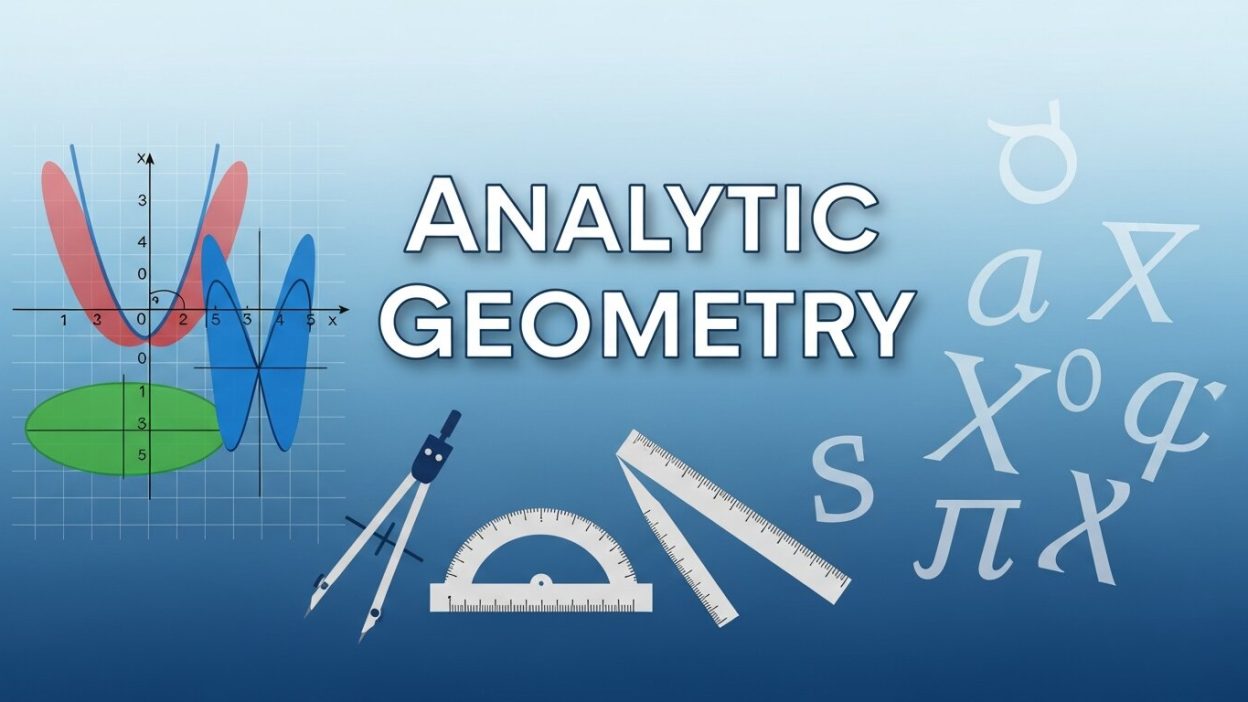
Analytic geometry, also known as coordinate geometry, combines algebra and geometry. It offers a method to learn about geometric figures by means of algebraic functions and a coordinate system. Driven by our ability to write points, lines, curves, and other forms on a (geometric) plane (or in (geometric) space), it affords us another way to address, analyze, and solve geometric issues.
Key Principles of Analytic Geometry
1. Coordinate Systems:
The Cartesian coordinate system is the backbone of analytic geometry. It uses points defined by coordinates (x, y) in two dimensions or (x, y, z) in three dimensions to represent geometric objects.
2. Equations of Shapes:
Shapes such as lines, circles, and parabolas are represented by equations. For example:
- The equation of a line is \( y = mx + b \),
- The equation of a circle is \( x^2 + y^2 = r^2 \).
3. Distance and Midpoints:
It provides formulas to calculate the distance between points and the midpoint of line segments using algebra.
4. Intersection of Shapes:
It allows us to determine where geometric shapes intersect by solving systems of equations.
Applications of Analytic Geometry
Analytic geometry is widely used in physics, engineering, computer graphics, and even economics. Its ability to convert geometric problems into algebraic equations makes it an essential tool in mathematical modeling and visualization.
What is Calculus?
Calculus is a field of mathematics that goes beyond geometry and algebra to study rates of change and accumulation. Developed independently by Isaac Newton and Gottfried Wilhelm Leibniz, calculus is fundamental to understanding natural phenomena and solving real-world problems.
Key Principles of Calculus
- Differentiation:
Differentiation deals with rates of change. For example, calculus can calculate the slope of a curve at any point or the velocity of a moving object.
- Integration:
Integration is about accumulation, such as finding the area under a curve, the volume of a solid, or the total work done over time.
- Limits:
Limits form the foundation of calculus, bridging the gap between algebraic expressions and continuous change.
- Functions and Rates:
Calculus explores how functions change over time or in relation to another variable. It can model systems ranging from population growth to the trajectory of a rocket.
Applications of Calculus
Calculus is extensively used in fields involving dynamic systems, such as physics, engineering, biology, and economics. It solves problems where rates or accumulated quantities are essential, such as optimizing processes in business or predicting natural events.
Key Differences Between Analytic Geometry and Calculus
Although analytic geometry and calculus work closely together, they are not the same. Here’s how they differ:
| Feature | Analytic Geometry | Calculus |
| Primary Goal | Study the properties and relationships of shapes | Analyze change and accumulation |
| Focus | Fixed shapes and their equations | Dynamic systems and continuous change |
| Approach | Algebraic and geometric | Derivatives and integrals |
| Application Examples | Finding the equation of a circle or line | Calculating the slope or area under a curve |
How Analytic Geometry Relates to Calculus
Though they are distinct fields, analytic geometry and calculus are deeply interconnected. Its provides the tools and framework to understand and visualize relationships that calculus explores.
The Foundation of Calculus
- Graphing Functions:
Calculus relies on analytic geometry to graph functions, as visual representation is critical for understanding rates of change and areas under curves.
- Defining Slopes and Tangents:
Differentiation in calculus uses concepts from analytic geometry, such as the slope of a line, to examine instantaneous rates of change.
- Intersections in Context:
Integration often involves defining the boundaries of shapes or regions, which analytic geometry helps describe algebraically.
An Example from Physics
Imagine trying to determine the trajectory of a ball in motion:
- Analytic Geometry describes the ball’s path using a parabolic equation like \( y = ax^2 + bx + c \).
- Calculus takes this equation and finds the speed, acceleration, or total distance traveled by using differentiation and integration.
Together, they enable us to analyze both the shape and the dynamics of movement.
The Verdict
Is analytic geometry the same as calculus? Not exactly, but they are in conversation. Analytic geometry allows us to represent geometric properties using algebra, which is then used by calculus to study change and accumulation. Consider them as opposing sides of the same coin, so to speak, both crucial to the modern world of mathematics and to applications in science and engineering.
When you understand their relationship, you can also become a better problem-solver in general, and you have a better idea of how math is really a giant system of pieces fitting together.
Interested in finding out more about these enormous fields? Check out our detailed guides for [Advanced Calculus Hacks] and [Mastering Analytic Geometry].
The Role of Mathematics in Modern Technology
Mathematics forms the backbone of today’s digital and technological systems. From designing mobile applications to developing artificial intelligence, both analytic geometry and calculus play significant roles. Analytic geometry helps structure graphical interfaces and spatial computations, while calculus supports algorithms that involve optimization and prediction. For example, in business environments, mathematical models assist in analyzing consumer behavior using tools like Data Marketing Analytics, where trends and measurable variables are evaluated for strategic decisions. These applications demonstrate how mathematical theory translates into practical digital innovation. Without the foundational concepts of coordinates, functions, and rates of change, much of today’s technological infrastructure would not function efficiently or accurately.
Mathematics in Business Strategy and Decision-Making

Businesses rely heavily on mathematical reasoning to make informed decisions. Analytic geometry assists in visualizing statistical data through graphs and coordinate-based models, while calculus helps measure growth rates, marginal costs, and revenue optimization. In customer-focused industries, mathematical tools are integrated into systems such as Customer Data Platforms, which organize and interpret structured information for better targeting and forecasting. These systems depend on mathematical modeling to detect patterns and predict outcomes. By applying concepts of change and relationships between variables, organizations improve performance and reduce risk. This demonstrates how abstract mathematical theories directly influence strategic planning and competitive advantage in the corporate world.
Mathematical Modeling in Computer Science
Computer science is deeply rooted in mathematical principles. Analytic geometry supports computer graphics, 3D modeling, and spatial recognition systems by defining coordinates and transformations. Calculus enhances machine learning algorithms by optimizing functions and minimizing error rates. Many modern analytical systems, including Computer Programs for Qualitative, rely on mathematical frameworks to interpret patterns, relationships, and structured data sets. These programs convert complex relationships into measurable outputs using formulas and logical structures. By combining coordinate-based modeling with rate-of-change analysis, developers create systems capable of simulation, automation, and predictive intelligence. This synergy highlights the importance of mastering both analytic geometry and calculus in technological innovation.
Visualization and Interpretation of Data
Visualization is one of the most practical intersections between analytic geometry and calculus. Graphs, coordinate planes, and geometric models allow analysts to interpret relationships between variables. Calculus further deepens this understanding by examining trends, slopes, and accumulated values across datasets. In digital marketing environments, mathematical models support campaign performance evaluation, especially within Email Marketing, where response rates and engagement trends are tracked over time. By combining graphical representation with change analysis, professionals gain actionable insights. This integration ensures that data is not only displayed clearly but also interpreted accurately, making mathematics essential in transforming raw numbers into meaningful conclusions.
The Importance of Graph Theory and Functions
Graphs and functions serve as bridges between analytic geometry and calculus. Analytic geometry provides the coordinate framework to plot equations, while calculus analyzes how these functions behave dynamically. Understanding curves, slopes, and intersections allows mathematicians and professionals to interpret real-world systems precisely. Functions represent relationships between variables, and calculus reveals how those relationships evolve. This is particularly important in scientific modeling, where small changes in one variable may significantly affect another. By mastering both graphical representation and rate-of-change analysis, learners develop a deeper comprehension of mathematical structures and their practical significance across disciplines.
Optimization and Efficiency in Engineering
Engineering frequently requires maximizing efficiency and minimizing waste. Analytic geometry assists engineers in designing structures and mapping physical dimensions accurately. Calculus, on the other hand, helps determine optimal solutions by analyzing derivatives and critical points. Whether calculating stress distribution or optimizing material usage, both disciplines work together to achieve precision. Engineers often rely on coordinate systems to model components, then apply calculus to refine performance measurements. This partnership between spatial representation and dynamic evaluation ensures accurate construction, mechanical functionality, and sustainable design. The combination highlights how mathematics supports innovation in infrastructure and technological development.
Predictive Analysis and Forecasting
Predictive analysis depends heavily on mathematical modeling. Analytic geometry helps structure datasets visually, while calculus measures trends and projected growth. By understanding slopes and cumulative change, analysts can forecast future outcomes with greater accuracy. These methods are commonly applied in economics, environmental studies, and population modeling. Mathematical forecasting relies on identifying patterns and quantifying variable relationships. Through equations and derivatives, professionals estimate long-term impacts and probabilities. This ability to predict future scenarios underscores the practical power of combining geometric structure with analytical change measurement, reinforcing why both fields are vital in research and planning.
Building a Strong Mathematical Foundation
A strong mathematical foundation begins with understanding coordinates, equations, and functions before progressing to limits and derivatives. Analytic geometry introduces learners to structured visualization, while calculus deepens analytical thinking about motion and accumulation. Together, they prepare students for advanced fields such as physics, engineering, economics, and computer science. Mastery of both disciplines enhances logical reasoning, problem-solving abilities, and quantitative literacy. Students who recognize how these subjects complement each other often perform better in higher-level mathematics. Ultimately, developing proficiency in both areas strengthens intellectual confidence and equips learners to tackle complex academic and professional challenges.
Frequently Asked Questions (FAQ)
1. Is analytic geometry the same as calculus?
No, they are not the same. Analytic geometry focuses on representing and studying geometric shapes using algebra and coordinate systems, while calculus studies change, motion, and accumulation using limits, derivatives, and integrals. They are closely connected but serve different purposes.
2. Which comes first: analytic geometry or calculus?
Typically, students learn analytic (coordinate) geometry before calculus. Understanding graphs, equations of lines, circles, and functions provides the foundation needed to grasp derivatives and integrals in calculus.
3. Can you learn calculus without analytic geometry?
It is possible, but not recommended. Calculus relies heavily on graphing functions, slopes, curves, and coordinate systems — all core concepts from analytic geometry. A solid understanding of analytic geometry makes calculus much easier to understand.
4. How are analytic geometry and calculus connected?
Analytic geometry provides the framework for graphing and describing functions, while calculus analyzes those functions to determine rates of change (derivatives) and accumulated quantities (integrals). For example, analytic geometry describes a parabola, and calculus determines its slope at any point or the area under it.
5. What are real-world examples of analytic geometry?
Analytic geometry is used in:
-
Computer graphics and animation
-
Engineering design
-
GPS and mapping systems
-
Architecture
-
Physics modeling
It helps convert shapes and spatial relationships into algebraic equations for analysis.
6. What are real-world examples of calculus?
Calculus is used in:
-
Calculating velocity and acceleration in physics
-
Optimizing business profits and costs
-
Modeling population growth in biology
-
Predicting economic trends
-
Engineering and machine design
It is essential whenever rates of change or accumulation are involved.
7. Is calculus harder than analytic geometry?
Many students find calculus more challenging because it introduces abstract concepts like limits and instantaneous change. However, a strong understanding of analytic geometry significantly reduces that difficulty.
8. Do engineers and scientists use both?
Yes. Engineers, physicists, economists, and other professionals regularly use both analytic geometry and calculus together. Analytic geometry models systems, and calculus analyzes how those systems change.
9. Why is understanding both important?
Together, analytic geometry and calculus form the backbone of advanced mathematics. Mastering both allows you to:
-
Solve complex real-world problems
-
Understand motion and change
-
Model systems accurately
-
Prepare for higher-level math and technical careers