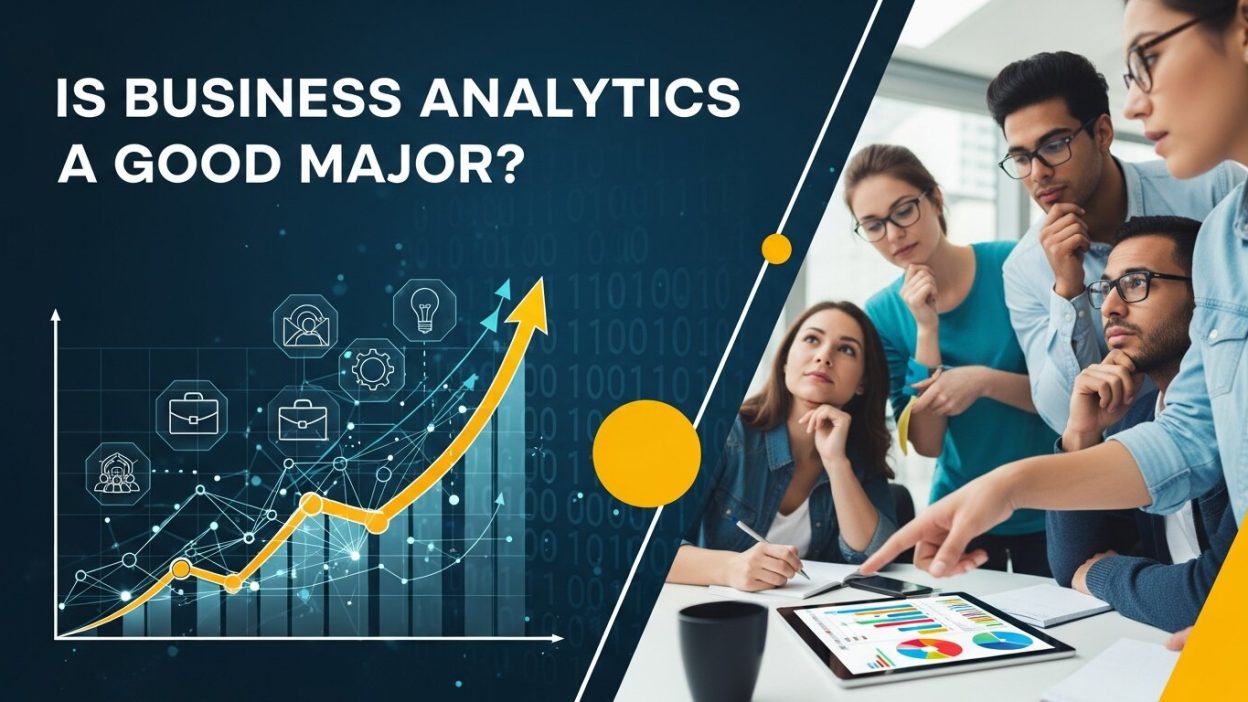
It’s business analytics that is changing how businesses make decisions, improve efficiency, and even outperform the competition in today’s data-driven world. That’s a market that integrates statistics, technology, and business strategy to transform raw data into actionable insights.
If you’ve been thinking about majoring in business analytics but aren’t too sure if you should, you may be wondering if it’s an ideal fit for you. Can you justify the investment in terms of time, effort, and money? What doors does this open for you upon graduation? This post will be able to answer most of your questions and help you determine if business analytics is the stepping stone you have been searching for.
What Is a Business Analytics Major?
A business analytics degree prepares you to analyze and interpret data, to solve business problems, and to effectively communicate results. It’s a multi-disciplinary field that incorporates parts of statistics, programming, and business theory.
Core Curriculum
Most business analytics programs cover foundational subjects like:
- Data Analytics & Visualization: Learn how to interpret data and present it in meaningful ways using tools like Tableau, Microsoft Power BI, or Python.
- Statistics and Probability: Understand statistical techniques to analyze patterns and predict outcomes.
- Programming for Analytics: Become proficient in coding languages like SQL, R, or Python for managing and analyzing databases.
- Data Warehousing & Big Data: Explore large-scale data storage and processing techniques.
- Business Strategy: Bridge your technical skills with business acumen to align insights with organizational goals.
Specializations
Many programs also allow students to specialize in specific areas, such as:
- Marketing Analytics
- Supply Chain Analytics
- Financial Analytics
- Sports Analytics
These niche specializations open doors to roles in highly targeted industries, letting you tailor your education to align with your interests.
Key Skills You’ll Learn
- Critical Thinking
- Presentation and Storytelling with Data
- Problem Solving
- Technical Proficiency in Analytics Tools
A business analytics major doesn’t just teach you quantitative techniques; it’s about equipping you with the ability to make data-driven decisions and communicate complex findings in simple and effective ways.
Career Opportunities
One of the biggest factors students consider when choosing a major is the career opportunities it offers. A degree in business analytics can open many doors, as businesses across every industry rely on analytics for growth.
Job Roles
Here are a few job roles you can land with a business analytics major:
- Data Analyst
Analyze data and prepare reports to guide business decisions. Median salary: $79,000/year
- Business Intelligence Analyst
Leverage analytics for strategic planning and operations. Median salary: $87,000/year
- Marketing Analyst
Use data to optimize customer targeting and campaign performance. Median salary: $73,000/year
- Operations Analyst
Improve efficiency and productivity within organizations. Median salary: $75,000/year
- Data Scientist
Combine statistics and machine learning to solve advanced business problems. Median salary: $102,000/year
Industries Hiring Analysts
The beauty of studying business analytics is its cross-industry applicability. Here are just a few industries where demand for analysts is growing:
- Finance
- Healthcare
- Retail & E-commerce
- Technology
- Sports & Entertainment
Data professionals are in high demand, and job growth in analytics-related roles is projected to grow significantly in the coming years, according to the Bureau of Labor Statistics.
Is It Right for You?
Before committing to business analytics as your major, it’s important to assess whether it aligns with your goals and interests.
Ask Yourself
1. Do you enjoy working with numbers and data?
Business analytics is built on data analysis, so comfort with numbers is key.
2. Are you excited by problem-solving?
A big part of the field involves finding solutions to business challenges using data insights.
3. Do you enjoy learning technical tools?
Whether it’s coding in Python or creating dashboards in Tableau, business analytics is a technical field.
4. What are your long-term career goals?
If you see yourself in a role that impacts strategic decision-making, this field could be ideal.
Skills You Need
You don’t need to be a math genius or a coding expert to succeed in business analytics, but certain traits and skills can make the process easier and more enjoyable for you.
- Analytical Thinking
- Curiosity
- Attention to Detail
- Communication Skills
If these resonate with you, a business analytics major could be a great way to build a fulfilling career.
Why Business Analytics Is a Smart Investment
Business analytics is more than just an academic field; it is a path to the in-demand, future-proof job marketplace. While organizations across all industries are actively pushing to digitize and optimize, we’re seeing unprecedented demand for analytics talent.
A degree in this industry puts you in a position to fill not just a job but a position that is in demand and empowering and meaningful. Whether you’re an entering freshman who wants to make an impact, a professional returning to school for a mid-life career change, or just want to learn more, a business analytics major creates a direct path to a successful future in the data-driven world.
When you’re ready for the first step, check out programs and opportunities that can help you meet your goals. The future of business is increasingly driven by analytics—and at the Institute of Business, we believe our graduates should be the leaders in this revolution.
The Growing Role of Data in Business Innovation
In today’s competitive landscape, organizations rely heavily on structured insights to guide innovation and long-term planning. Companies no longer depend on intuition alone; instead, they collect, organize, and interpret large volumes of information to uncover patterns and opportunities. From product development to customer experience improvements, data plays a central role in shaping smarter strategies. Modern businesses integrate advanced systems such as Customer Data Platforms to unify information from multiple sources and create a complete view of their audiences. This integrated approach allows leaders to anticipate trends, personalize services, and respond quickly to market shifts. As digital transformation accelerates, data-driven innovation is becoming a fundamental driver of sustainable business growth and competitive advantage.
Practical Applications of Analytics in Daily Operations

Business analytics is not limited to high-level strategy; it directly improves day-to-day operations across departments. Managers use insights to optimize inventory levels, streamline supply chains, monitor employee performance, and reduce operational costs. Marketing teams analyze campaign performance to refine messaging and increase return on investment. Finance departments rely on predictive models to manage risk and forecast revenue more accurately. Even human resources teams use analytics to improve hiring decisions and employee retention strategies. By embedding analytics into everyday processes, organizations create a culture of continuous improvement. This practical integration ensures that decisions are backed by measurable evidence rather than assumptions, ultimately increasing efficiency, productivity, and overall organizational effectiveness.
Understanding Top Data Analysis Techniques
A strong foundation in analytics requires familiarity with Top Data Analysis Techniques that help transform raw numbers into meaningful conclusions. These techniques include descriptive analysis to summarize past performance, diagnostic analysis to uncover causes behind trends, predictive analysis to forecast future outcomes, and prescriptive analysis to recommend optimal actions. Mastering these approaches enables students to tackle real-world challenges with confidence and clarity. By applying structured methods, analysts can reduce uncertainty and improve the reliability of their recommendations. Learning how to choose the right technique for a specific business problem is just as important as understanding the tools themselves, making analytical methodology a critical component of professional success.
The Impact of Data Marketing Analytics on Customer Engagement
Marketing has evolved significantly with the rise of advanced analytics tools and measurable performance metrics. Through Data Marketing Analytics, organizations can better understand customer behavior, segment audiences precisely, and design highly targeted campaigns. Instead of broad, generic messaging, businesses now tailor communication based on purchasing patterns, preferences, and engagement history. This data-driven personalization increases customer satisfaction and strengthens brand loyalty. Analytics also enables marketers to track performance in real time, allowing them to adjust strategies quickly for maximum impact. As competition intensifies across industries, the ability to leverage marketing data effectively becomes a powerful differentiator that drives revenue growth and long-term customer relationships.
Ethical Considerations and Responsible Data Use
As data collection expands, ethical responsibility becomes increasingly important. Organizations must ensure transparency, privacy protection, and secure handling of sensitive information. Responsible data practices not only protect customers but also strengthen trust and brand reputation. Business analytics professionals are expected to understand regulatory frameworks and apply ethical judgment when interpreting and sharing insights. Misuse of data can lead to legal consequences and long-term reputational damage. Therefore, education in analytics should include discussions about governance, accountability, and fairness. By prioritizing ethical standards alongside technical skills, future professionals can contribute to a data-driven environment that balances innovation with integrity and respects the rights of individuals.
Building a Competitive Advantage Through Analytics Skills
Analytics expertise gives professionals a distinct advantage in today’s job market. Employers seek individuals who can interpret complex information and translate it into strategic recommendations. Strong analytical skills allow graduates to identify inefficiencies, reduce costs, and uncover growth opportunities. Beyond technical ability, the capacity to communicate insights clearly to non-technical stakeholders sets top candidates apart. As automation handles repetitive tasks, human judgment and analytical reasoning become even more valuable. Developing these competencies prepares students not only for entry-level roles but also for leadership positions. Over time, analytics-driven thinking empowers professionals to shape strategic direction and contribute meaningfully to organizational success.
Preparing for a Long-Term Career in a Data-Driven Economy
Choosing a field aligned with future market demands is essential for long-term stability and growth. As industries continue adopting digital systems and intelligent technologies, analytics knowledge remains highly relevant. Continuous learning, certification programs, and practical experience further enhance career prospects. Graduates who stay updated with emerging tools and industry trends maintain a strong professional edge. Networking, internships, and real-world projects also play a crucial role in career advancement. A foundation in analytics does not limit opportunities; instead, it opens pathways across multiple sectors. With adaptability and commitment to growth, professionals can build resilient, rewarding careers in an increasingly data-centered global economy.
Frequently Asked Questions (FAQ)
1. What is a business analytics major?
A business analytics major focuses on teaching students how to collect, analyze, and interpret data to solve business problems and support strategic decision-making. It combines statistics, programming, data visualization, and business strategy to transform raw data into actionable insights that organizations can use to improve performance.
2. Do I need to be good at math to major in business analytics?
You do not need to be a math genius, but you should feel comfortable working with numbers and learning statistical concepts. Most programs teach the required math and analytics foundations step by step, so dedication, logical thinking, and a willingness to practice are more important than advanced math skills.
3. What programming languages will I learn?
Most business analytics programs include practical training in tools and languages such as Python, SQL, and sometimes R. You will also likely learn data visualization platforms like Tableau or Power BI. The goal is to develop hands-on technical skills that employers expect from analytics graduates.
4. What jobs can I get with a business analytics degree?
With a business analytics degree, you can pursue roles such as Data Analyst, Business Intelligence Analyst, Marketing Analyst, Operations Analyst, or even Data Scientist, depending on your skills and experience. These roles focus on analyzing data, identifying trends, and helping organizations make informed decisions.
5. Is business analytics in high demand?
Yes, business analytics professionals are in high demand because companies across industries rely on data to guide strategy and improve efficiency. As digital transformation continues, the need for skilled analysts is expected to grow steadily in the coming years.
6. What industries hire business analytics graduates?
Business analytics graduates can work in finance, healthcare, retail, e-commerce, technology, sports, entertainment, and many other industries. Since almost every modern organization uses data, the skills you gain are highly transferable across sectors.
7. How is business analytics different from data science?
Business analytics focuses more on applying data analysis to business strategy and decision-making, while data science often involves deeper programming, machine learning, and model development. Business analytics typically emphasizes business understanding along with technical skills.
8. Is business analytics a good major for career changers?
Yes, business analytics is a strong option for career changers because it offers practical, in-demand skills that can open doors to various industries. Many programs are designed to support students from diverse academic and professional backgrounds.
9. What skills will I develop in a business analytics program?
You will develop analytical thinking, problem-solving ability, data visualization skills, technical proficiency in analytics tools, and strong communication skills. These competencies help you not only analyze data but also present insights clearly to decision-makers.
10. Is a business analytics degree worth the investment?
For many students, a business analytics degree is a worthwhile investment because it offers strong career prospects, competitive salaries, and long-term relevance in a data-driven economy. If you are interested in combining business strategy with technical skills, it can be a powerful pathway to a successful career.